Search

Fall Prevention

Typologies

Accessories

Our catalogue

Discover all our innovative solutions in one comprehensive catalogue.

PROJECTS

Our Successful Projects

Oil&Gas

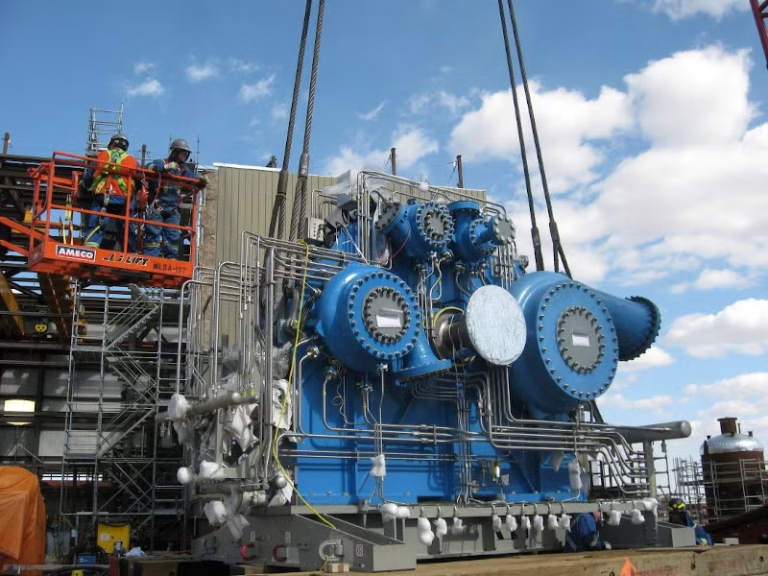
Garraf Field – Gas Dehydration Plant

Situated in the Thi Qar province, approximately 5km northwest of Al-Refaei city and 85km north of Nasiriya, the Garraf oil field has an onshore location. Discovered in 1984, this oil field contains oil reserves within Cretaceous reservoirs. Spanning 17.5km in length and 5.5km in width, it is estimated to harbor 1.3 billion barrels of oil. Upon reaching full production, the field’s production capacity is projected to escalate to 230,000 barrels of oil per day (bopd). Transportation of the oil field’s products is facilitated through a 13km pipeline to the Gharraf-Badra tie-in area (GBTA). Subsequently, it is conveyed via a 28-inch, 92km pipeline to the Nassiriyah storage depot.

Petrochemical

Project CERES

The Ceres Urea Plant, located on the coast of Western Australia, is a large onshore facility for the production of ammonia and urea from natural gas. Once completed, it will be the world’s largest gas-based ammonia and urea production plant. It uses local natural gas to produce fertilizers, integrating ammonia production, urea production, granulation, auxiliary services, port infrastructure and water supply facilities. The plant will include production areas, storage facilities and administrative functions. A 3.2 km conveyor belt will connect the plant to the port for the transport and loading of urea intended for export. The facility is designed to contribute to the target of achieving net-zero carbon emissions by 2050.

Bioenergy

H2GS — Sweden — 2.1 MTPY HDRI and BRI Plant

H2 Green Steel was launched in 2021 in Boden, northern Sweden, is designed to produce 2.1 million tonnes per year of hot direct reduced iron (HDRI) and hot briquetted iron (HBI) using fossil-free hydrogen-based direct reduction technology. The project aims to decarbonize steel production by replacing fossil fuels with renewable hydrogen during the iron reduction process. Integrated with an electric arc furnace (EAF), the plant is expected to reduce CO₂ emissions from ironmaking by up to 95% compared with conventional blast furnace technology, supporting the production of near-zero-emission steel. The start of production is planned in 2026.

Get in touch

Do you have a question or need specific information? 
Write to us and we can best advise you.

Request a quote

Our technicians will be able to support you in analyzing all your needs and identifying the most suitable product for your needs